
Many people have asked me questions regarding the handling of banking and financial matters as an expat in Italy, as well as the cost of living in Rome. As always, I’m here to help. Just send me your account number, routing number, and SWIFT code and I’ll take care of everything for you. Then if you have any further inquiries, just email me and I’ll be in touch…eventually. (By the way, how’s the weather in Brazil this time of year?)
But seriously, it can be a real challenge to deal with these sensitive issues in a foreign country, using foreign currency, and dealing with foreign people who are speaking a foreign language. It’s scarier than seeing a foreign doctor in some ways…at least you can assume that a doctor has your best interests in mind. Dropping your pants in front of a total stranger is one thing, but handing them your money is really something quite personal.
For this reason, I’ve asked an expert in financial matters to post some useful information on my blog. He has written an article which will appear here in a couple of days. In the meantime, I’ll attempt to answer a few of the more pedestrian questions myself that arise from time to time.
Credit is extended to Mamma, all others pay cash
First know that Italy is still very much a cash society. Credit cards are accepted reluctantly or not at all in many places. The average Italian citizen makes 26 credit card transactions a year. According to the Bank of Italy, that’s half the European average (which in itself is way below the US average). Rome is a big city and a major tourist destination, so it is easier here than the rest of the country.
But don’t count on using your American Express to pay the barber or the butcher. Besides, most credit card companies charge a significant foreign transaction fee, so it would be to your advantage to get out of the habit of using plastic for every small purchase. Back in the States I hardly ever carried more than $20-30 in my wallet and I used to use a credit card for everything, even a $3.00 coffee at Starbucks. Here in Italy, I visit the Bancomat once or twice a week and use that money to pay for all my expenses, including my rent.

Why is this, you might wonder? Well, Italy’s culture of cash is deeply rooted in its history. Strong family traditions have made them great savers in order to ensure their children’s financial future.
A reluctance to use credit cards has also made them the euro-region’s least-indebted consumers. They love owning a house, but at the same time the mortgage lending system is much more restrictive than in the US (you actually have to prove that you’ll be able to afford the monthly payments). Consequently, Italy largely avoided the global real estate bubble during 2002-2007.
Great, but you might ask: how does that affect me? I tell you all of this just to underscore the important fact that you need to start thinking about using cash for almost everything, including your rent. But watch out for your wallet in crowded places. Getting pick-pocketed by a gypsy on the Metro is almost a rite of passage to living in Rome.
The Cost of Living in Rome
As far as the cost of living in Rome, it is equivalent to any big international city. In fact, it’s much cheaper than New York, London, or Tokyo. Nevertheless, it’s more expensive than living in a suburb or small town. Some things are more expensive in Italy than in the U.S., notably energy costs; fuel, electricity, heating, etc.
On the other hand, some things are much cheaper, such as food and wine. These items are not only cheaper in Rome than almost anywhere in the U.S., but as everyone knows, the quality is also much higher. Start your diet before you go and then leave your guilt at home. Life’s too short to eat bad food and drink bad wine.
OK, let’s talk about some specifics. Obviously, your greatest expense will be rent. Like in all cities, the cost of rent is relative to the size, condition, and location of the property. If you choose to find a studio apartment or a (very) small one-bedroom by yourself, you’ll likely pay 900-1100 Euros a month, including utilities.
If you find a flatmate to share an average two-bedroom place, you’ll reduce your cost to 650-700 a month. I should mention that these figures assume that you will not be living in Piazza Navona or on the Via Veneto. Rather, I am referencing the neighborhoods that are just outside of the historical center. Piazza Bologna, San Giovanni, EUR, etc.

As far as food, of course it depends on how much cooking you do at home versus eating out. As a general rule, you can say that packaged foods cost about the same here as in the U.S. Fresh meat, fish, and produce are a little cheaper in Rome than in the average U.S. city, but of a much higher quality. And now here’s the really good news: wine is about half the price! Salute!
Having a car in Rome is not only expensive, but it’s also inconvenient. It’s a big headache that you just don’t need. Gasoline costs 3-4 times as much as in the U.S. and there’s nowhere to park. Using a scooter amounts to playing Russian Roulette by proxy. The so-called rules of the road are completely different here. Don’t get me wrong, there are rules. But if they weren’t programmed into your DNA at birth, then you’ll never be able to understand them. Don’t even try.
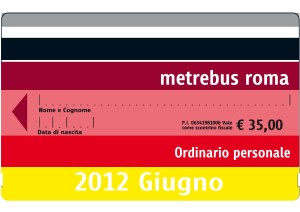
For these reasons, I strongly recommend using public transportation. The public transportation in Rome, while not perfect, offers many more choices than in the U.S. For 35 Euros you can buy a monthly pass (abbonamento mensile) for unlimited use of all the buses, trams, subways, and commuter trains.
These tickets cover you not only in the city proper, but also up to 30 kilometers (18 miles) from the downtown area on the “metro trains.” It’s one of the best bargains in all of Europe, even if you have to deal with the occasional strike (Lo Sciopero). Don’t get me started on that topic again.
So now let’s do some math for your typical fixed-cost monthly expenses. Assuming you share a two-bedroom flat (your own bedroom, shared bathroom), housing will be about 650 Euros, including utilities. Let’s say 200 for groceries and 35 for transportation. That comes to 885 Euros a month. Add a little more for entertainment and miscellaneous expenses and you’re now over 1,000 Euros.
Which doesn’t seem too bad, right? But when you consider that the average Italian take home pay is about 1,200, you can begin to see why many choose to live at home for as long as possible.
Final thoughts
So that’s the basics, and if your’re staying in Rome for a year or less, then that’s probably enough information. But what if you decide to make the move permanently? Should you open an Italian bank account? Should you transfer all or most of your US assets to Italy and convert to Euros? What about buying property in Italy?
I’ll address these questions over the next couple of months. As I mentioned in the beginning of this post, I have invited an economist to write about some of these issues which will be posted here on my blog in a few days.
Until then, you can feel free to send me all of your financial information via email. I promise that I will treat it with the utmost professional care and discretion–you can trust me, I’m a doctor (well, I used to be, anyway). And if you need to discuss it, don’t forget that Brazil is four hours behind Italy…adeus!

Hi Rick,
I’m an American spending 6 months of the year in Paris but would love to live in Rome possibly all year around and have access to all of Europe. I found your blog looking for flats to rentbuy in Rome … a bit daunting. I would love to have a stable professional person to guide and advice me. What’s your suggestion, please!
Thanks for this informative article. Where did you find this credit card transaction per year information ?
Gosh, sorry, I don’t remember, I wrote this like 5+ years ago. Not sure the number are still 100% accurate.
Living in rome is really very expensive. I am planning a trip to Italy and Liguria for 15 days with my lovely family and looking for some best restaurants to dine out there and best destinations for visit. Please suggest me something for a pleasant holiday.
Here you go! http://rickzullo.com/italy-restaurant-guide/
Rick,
I just happened upon your blog today and would love to know if there is anything new since first done. With the changes in the EU and immigration to Italy I didn’t know how the euro now stacks up. If it is harder or easier now to live that dream. Especially the cost of living in Rome. How long can I live there with $10,000.
Wow, those are some complex questions, Elaine. But in general, not much has changed regarding the cost of living. Sure, there’s been some inflation, but the dollar is also stronger vs. the Euro now. I don’t know how/if the immigration figures into the equation. But it’s always been hard to survive financially in Rome. As for your $10,000, of course it depends on your style of living. For an average person, I think you could stretch it for 4-5 months, give or take a month.
Rick,
Just happened upon your blog this June 2017. Very interesting information.
Am in the USA but did a bit of wistful thinking about Italy.
😉
That’s great, thanks! Make it happen asap!
Greetings, Rick. Your hilarious and informative blog earns cinque stelle from me. And if you happen to know the answer to my question, I owe you lunch: will the Schwab brokerage account checking account feature satisfy the residency requirement for having approximately $7000 in an Italian bank? I have Italian citizenship and plan to establish residency come January. Much obliged, Joanna
Hi Joanna…. I will reply via email. Ciao!
Rick – Thanks, this information is really useful.
I have a 1 year contract with a company and have my tickets booked for Rome next month. In that regard, your posts in addition to those on Expat blog (http://www.expat-blog.com/) have helped to a reasonable degree in preparing for an imminent and whats seems likely to be a chaotic adventure. It’s good to know I won’t be the only one wracking my brains over the Italian bureaucracy, though growing up in India should help cope.
Quick question – Any idea how I can get to work at Zona Industriale Paduni-Selciatella? I’ve read that its pretty far from Rome, and was contemplating if a car would be necessary. I definitely want to stay in the city though, even if the commute is a little longer everyday.
Thanks again,
Rahul
Sorry Rahul, I really have no idea, as I’ve never been there. I always advise NOT having a car, if possible, however. Just too expensive, and in the end, more inconvenient. Public transportation is the lesser of two evils, in my opinion.
No problem, thanks for replying, I’ll keep that in mind. – Rahul
I’ve always wanted to live in Rome and connect with my roots. My father is from Italy and my mother is Italian American. I have my Italian passport and codice fiscale. I speak an intermediate level of Italian, but for some reason, I have this unshakable fear of the job market and being poor there.
Ideally, it’d be great to find an American company that wants a remote worker to help European customers, but that’s not a guarantee.
Truth be told, I’m a writer almost finished with my first novel about interwar Italy, and feel like it needs to be written in Italy.
What do I do!
PMV
Ha, ha…well, it’s not a fear, it’s a reality. The job market is miserable. Then again, if you’re a writer, you’re used to being poor! Yes, finding an American company to transfer you to Italy would be ideal. Then again, so would winning the lottery, which is essentially the same odds. Good luck!
You’re wrong on the meat and fish. Waaaaaaay off.
Hi Rob. You’re comment isn’t too specific, so it’s difficult to know what you mean. You don’t mention whether my estimates are too high or too low; nor do you say what (where) you’re comparing them to. Care to elaborate? And are you talking about supermarket prices or local daily markets? Big cities or small towns? There are many many variables which should be considered.
Thanks, Rick. Very useful information.
You’re welcome!
Hi Rick,
I’m yet another fan – really look forward to reading your latest!
I lived in Milan for a few years and, after arrival, it took me about 6 months to get the courage to get behind the wheel. First day out, was driving through the centre of Milan when a car screamed up behind me and then mounted the pavement to overtake ! Was having second thoughts about driving in Italy when the next car that overtook me (on the pavement of course) was a police car in hot pursuit ….
Ciao Lisa and thanks for your kind words! I love your story about the police chase on the sidewalk. While quite amusing, I can’t say that I find it terribly surprising. Thanks for sharing!
Rick
Hey Rick, I’m loving your blog. I, too, have a dream to live in Italy. I tried it once 5 years ago, but it didn’t work out for various reasons. But the dream lives on! The information about the cost of living in Rome is really great. I’m curious, though, about how much an English teacher would generally/on average make per month? I realise it must depend on a lot of factors, but a general idea would be very welcome. Grazie mille.
Hi Clare! Thanks so much for your comments and support. As far as teaching English in Rome, the standard going rate at one of the many private language schools is about 11-15 Euros per hour ($15-20). That said, if you find your own private students, you can (and should) charge twice that amount because you’ll also have to spend a lot of time scheduling, arranging lessons, finding students, etc. And then there other people who have randomly feel into jobs that pay 25-30 Euros an hour. That happens, but it’s the exception.
In any case, DON’T let the dream die!
Ciao, Rick
Hey Rick, great post! Thank you for explaining the “cash” thing in Italy. When I rented an apartment in Trastevere last fall, my understanding was that I was to wire money directly to the company. As a New Yorker, that made me uneasy. I, like you, am used to credit/debit transactions for almost everything. (Plus, I was worried being mugged or followed after I’d obtained the cash!) But when they turned around and told me to bring CASH, I was like, “What the h-e double hockey sticks?” I was staying two weeks!!! It was a lot of money pick up and carry through the streets of NYC and two airports. Everything worked out just fine, but I’m not a fan of the cash thing.
In addition, I agree with you on how much more fresh and delicious the food is. But can you please explain to me why milk goes bad within 3 days? I thought it was my imagination, but an Italian friend confirmed that it goes bad quicker in Italy than the States. Perché?
Grazie ancora!
I don’t know about the milk in the States, but the milk you saw expiring in 3 days should be the “latte fresco”, a milk pasteurized at low temperatures usually milked not more than 48 hours before. This guarantees the death of bacteria without losing much of original milk proprierties, but this shortens the expiry date (sually the days written are not the true expiry date, but for laws they must indicate some days before the truly dangerous expiry date). YOu can find also long-life conservation milk (pasteurized at high temperatures), which, not open, can last months, but I can assure you the difference in the flavor is evident. Usually the latte fresco is used for the direct consume, the lunga conservazione for cook.
Grazie, Davide! I also answered the question before noticing that you had already done a much better job explaining it!
Rick, truly “latte fresco” isn’t common in USA Cities? (I think in rural area should be). Strange because I know in other European Country is consumed also (we import latte fresco also from Germany)
Sadly, Davide, it’s true. As you say, I’m sure you can find it in some rural areas, but at the big supermarkets in most cities, no.
Ciao Adelina and thanks for the comments! As far as the milk, there are normally two types: “latte fresco” and “latte a lunga conservazione.” The first type has no added preservatives and therefore only lasts about 3 days, as you mentioned. The other type lasts longer, but of course has added chemicals–yuck!
Oops! I just noticed that Davide already answered the question better than I did! Oh, well….
Please bear in mind that new laws passed in 2012 make payments in cash over €1000 subject to government scrutiny. This is apparently an effort to counteract the Italian tendency not to declare income. So you can expect credit-card transactions to increase rather a lot. This goes counter to the general Italian suspicion of banks, credit cards, and “rintracciabilità” or a paper trail — Italians are passionate and expert tax evaders and cash, lovely cash, is everyone’s favourite method of payment. But with the new law you can’t pay cash for a new computer or a new anything over €1000 without a special red flag going to the Agenzia delle Entrate, the tax agency. This could lead to audits or all sorts of unwelcome tax-related attention. So the new law is aimed to change Italians’ preference for cash. We’ll see what happens.
Thanks, Anthony, I wasn’t aware of those changes. I can foresee a lot products being “on sale” for €999! (Or some other such creative financing). I appreciate you sharing this helpful information on my blog…grazie!
Ciao, Rick
Thanks Rick! This is exactly what I’ve been looking for.
Keep up the good work.
You’re welcome, Lewis. If/when you have any specific questions that I have yet to address on the blog, please just shoot me an email.
Good luck…you’re in for a great adventure!
Rick
Rick, I not only appreciate your personality that shines through in your blog, but also the information that you provide. For those of us “wannabes” that hope one day we will fulfill our dream of living in Italy (okay, perhaps retire there before we are 100 years old!), your experiences, observations and information is greatly appreciated! Signed, your new fan. 😉
Wow, thanks Carol! I really appreciate your words of encouragement. And don’t worry–I’m sure you’ll realize your dream someday. In the meantime, enjoy the dream itself; it’s part of the fun! Ciao!
Rick, I am new to your blog, which by the way is great! We have been to Italy two times. First time in June, 2002 and second time, June 2015 for our Golden Anniversary with our three children and four grandchildren. It was amazing to spend this special day with them. We LOVE Italy. My dream came true when we were able to bring our family to Italy. They always talk about it.
I will keep reading more and more about Italy…….there is so much to know.
Next dream, to live there for one year, that way our friends and family can come for a visit.
Signed, another new fan. : )
Hi Diane! Thanks so much for the kind words! Yes, to get the “full experience,” you really need to live in Italy for a year…or two! Best of luck to you, Rick
I really love your blog and your honesty Rick. As a South African I have found things to be much cheaper in general. Ok – in South Africa the quality of accommodation is generally much better and you get more value for money in the suburbs and also much more modern places. But when it comes to everything you can buy at the supermarket – well…SA is far more expensive. I can eat very healthily for little here whereas in SA it is more expensive to eat healthy food.
Thanks Elizabeth! Yes, I agree with you. Same in the US: you get “more” for your money as far as accommodations, but other daily expenses are cheaper in Italy (exception: energy costs). And things are much cheaper still if you get out of the big cities, of course. Thanks for your comments and I’m enjoying your blog, too! (notice the Zemanta?)!
I live in London which is extremely overpriced – renting a room in a half decent area that is more than half hour from the centre, sharing with more than 2 or 3 is still roughly over 700 euro without bills. Transport is 140 euro to get into the centre each month and we also have regular delays and strikes. I would say Rome has the edge, although as you mentioned, salaries are lower. I am moving to Rome in September but rent will not be a shock to me when I think what I pay in London! Look forward to more info on this topic,especially about opening a bank account there as I have heard it is not easy at all if you’re a foreigner!
Hi Rowena, and thanks for commenting. Yes, that’s the trick in Rome–it’s not terribly expensive, but the wages are quite low. Still, everybody seems to manage somehow (“l’arte di arrangiarsi”). Regarding banking, I do some information on that which I plan to post soon. But it’s sort of aimed at Americans, as I’m not familiar with the banking practices in the UK.
In any case it would depend on how long you’re staying in Italy. If you’ve already committed to a permanent move, then yes, you’ll need to set up an Italian bank account. But if you’re uncommitted or know that you’re only staying for a year or less, then I’d look for a way to use your English bank–at least in the short to mid term. Ciao!